Best Mosquito Net For Sleeping Bag: Trail-Tested Picks
By Diego Martins • 21st Sep
Quick verdict
There is no evidence-based overall winner or genuine “trail-tested” pick here. Choose 4Monster for clearer manufacturer-published sizing and storage-bag measurements; choose AceCamp for listed top and corner loops, retailer-listed weights, and a 341-holes-per-square-inch mesh claim.
- Choose 4Monster if: You value published Single and Double dimensions plus compact storage-bag measurements, and can supply your own hanging line or hook.
- Choose AceCamp if: You want identified pitch points and listed weights for both sizes. Its mesh figure and fit claims come from a retailer listing, not independent testing.
- Main trade-off: 4Monster has clearer first-party sizing but no listed weight or included hanging hardware; AceCamp has more setup and mesh detail but no established packed dimensions.
Important: Before relying on either net, test-pitch it with your pad and sleeping bag, keep the mesh off your body, inspect for damage, seal the ground edge, and keep it away from fire.
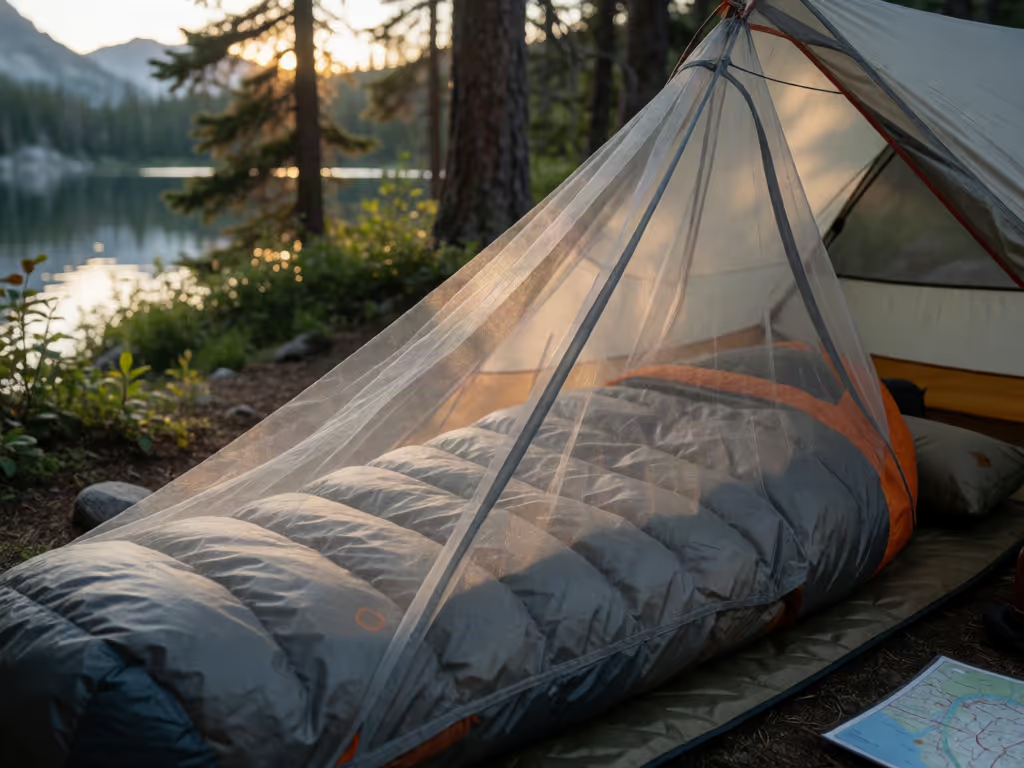
A mosquito net for sleeping bag is only as good as its perimeter seal, overhead clearance, and the pitch you can actually make at camp. That is why I would not hand out a "trail-tested best" badge here: the available product details compare two sleeping-system mosquito-net options, but do not include independent field testing, durability testing, or hands-on setup results. What they do reveal is more useful than marketing superlatives: where each net has a clear fit advantage, where the data run out, and which missing pieces can turn a lightweight mosquito net camping plan into a long night of bites.
For ground sleepers, the practical winner is the net that fits your pad-and-bag footprint without lying on your skin, can be sealed at the ground, and can be pitched with the anchors available at your campsite. A fine-looking mesh specification does not rescue a gap at the corners.
Price-to-warmth matters, but failure costs the most outdoors. The same logic applies to bite protection: a cheap net that cannot be pitched tightly is not a value.
The short answer: choose by sleep-system geometry, not brand loyalty
This comparison covers two nets with published sizing and setup details for sleeping-system use. The comparison is constrained, but the decision path is still clear.
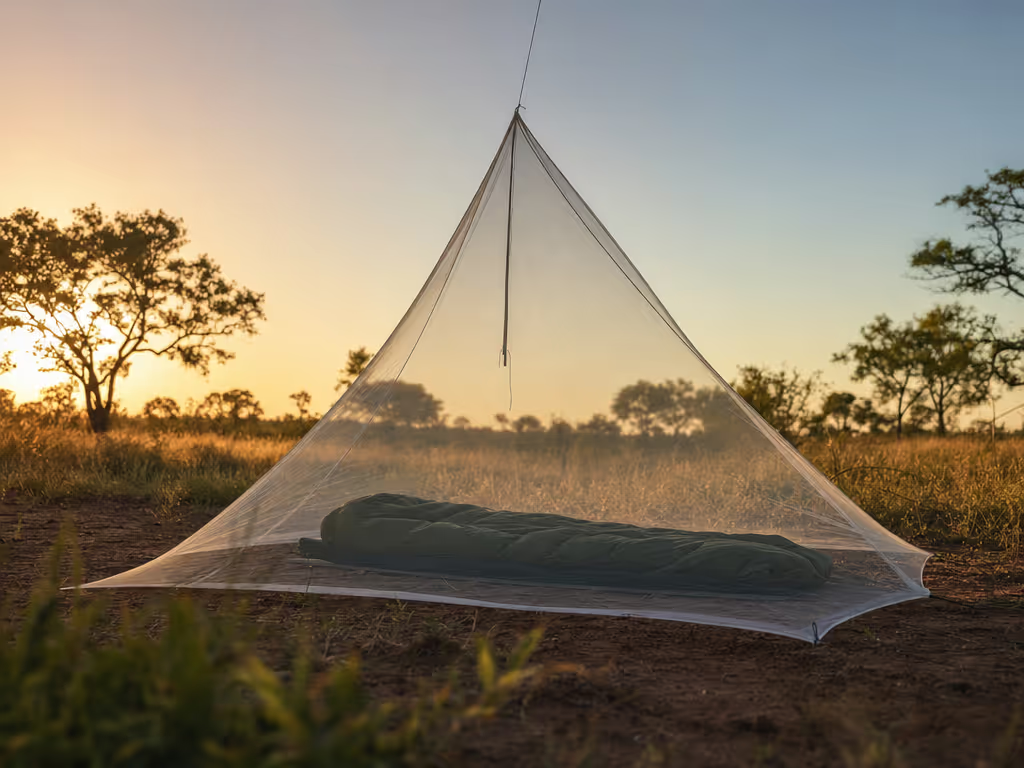
- Choose the 4Monster Mosquito Camping Insect Net with Carry Bag if published dimensions and compact storage-bag measurements are your priority, and you are prepared to supply your own hanging line or hook. Its manufacturer offers distinct Single and Double versions and says it can be hung inside or outside a tent.
- Choose the AceCamp Mosquito Net if you want retailer-listed pitch points already identified: an open loop at the top and loops at the corners. The retailer also lists a mesh density of 341 holes per square inch. Treat those retailer specifications as useful shopping information, not an independent performance test.
- Skip both for this trip if you cannot create a suspended peak and seal the base around your sleep system. A net draped across a bag is a red flag, not sleeping bag mosquito protection.
Neither product can fairly be called the overall best from the available evidence. There is no verified comparison of real-world insect exclusion, fabric longevity, packed volume on the AceCamp, or how easily either net pitches in wind, rain, trees, or sparse terrain.
Comparison: the usable numbers, and their limits
4Monster Mosquito Camping Insect Net with Carry Bag
The 4Monster is available in Single and Double sizes. The manufacturer lists the Single at 39 × 47 × 94 inches and the Double at 51 × 67 × 94 inches. It also lists storage-bag dimensions of 4.7 × 7.5 inches for the Single and 5 × 9 inches for the Double. Those are two bag dimensions, not a complete packed-volume measurement.
The manufacturer describes the net as 50D microfiber and says it can be hung inside or outside a tent. It includes a polyester storage bag with a handle.
Green flags
- Separate Single and Double dimensions make it easier to start with your actual sleep-system footprint.
- Published storage-bag measurements help when every pocket in your pack has a job. For packing and compression practices that protect insulation and preserve loft, review this sleeping bag packing guide.
- The option to hang it inside or outside a tent gives you more configuration flexibility, according to the manufacturer.
Red flags
- No hanging strings or hook are included. Put cordage or a suitable hook on your packing list; otherwise this is just netting waiting for an anchor.
- No manufacturer-published weight was available, so do not use it for precise base-weight math.
- No numeric mesh density was available. The 50D material description is not a substitute for a hole-count specification or a field efficacy test.
This is the more transparent choice on dimensions, but it asks more of your setup planning. In plain language: it may fit neatly on paper, yet a poor overhead anchor still leaves you with mesh on your face and arms.
AceCamp Mosquito Net, Camping Insect Net with Carrying Bag
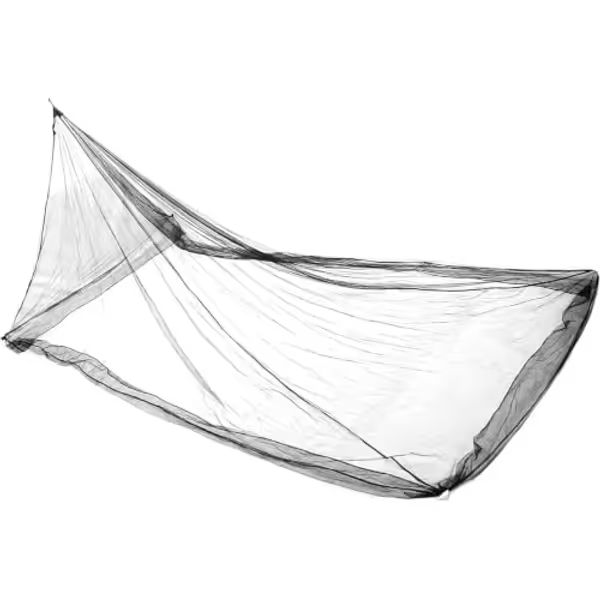
The AceCamp has retailer-listed dimensions of 7.9 × 3.9 × 3.3 feet for the 1-person version and 7.9 × 5.6 × 4.3 feet for the 2-person version. Listed weights are 0.5 pound and 1 pound, respectively. The retailer describes the selected sizes as fitting one or two sleeping bags and lists 341 holes per square inch.
Most importantly for setup, the retailer lists an open top loop plus loops at each corner. The top loop can be hung from a branch or rope, while the corners can be staked. Stakes are not included; the retailer says they are recommended but not necessary.
AceCamp Mosquito Net
Essential bug protection for comfortable, uninterrupted outdoor sleep.
Weight (1-Person)0.5 lbs
Weight (1-Person)0.5 lbs
Pros
Versatile for bags, tents, beds & cots
Effective bug protection with strong mesh
Easy and flexible setup options
Lightweight with included carrying bag
Cons
Some users find it small for larger beds
Customers praise its effective bug protection, strong mesh, and easy setup, though some find it a bit small.
Customers praise its effective bug protection, strong mesh, and easy setup, though some find it a bit small.
Green flags
- The stated top and corner loops create a straightforward pitch plan: suspend the peak, then tension and seal the corners.
- The retailer provides weights for both sizes, making like-for-like Single versus Single or Double versus Double comparisons possible.
- The 341-holes-per-square-inch claim is a concrete mesh figure. For context, CDC general guidance advises selecting a net with 156 holes per square inch; that guidance is not a certification or a comparative test of this net.
Red flags
- These product specifications come from a retailer listing rather than a collected first-party AceCamp product page or manual.
- No packed dimensions were established, so you cannot confidently compare its carried bulk with the 4Monster's listed storage-bag measurements.
- Stakes are not included. If you plan to use them with the corner loops, add them to your packing list; the retailer recommends stakes but says they are not necessary.
How to choose the right size for your sleeping bag and pad
Do not select by the label "one-person" alone. For a fuller look at how dimensions affect warmth and usable space, see this sleeping bag size guide.
Use this three-step check before buying a bug net for backpacking:
- Compare the selected net's published dimensions with your sleep system. Keep Single and Double figures separate, then confirm the fit with a test pitch before your trip.
- Plan the peak before the trip. Your setup needs a reliable overhead anchor. For the 4Monster, add your own hanging line or hook. For the AceCamp, its listed top loop still needs a branch, rope, or another suitable anchor.
- Plan the ground seal. CDC guidance for mosquito nets emphasizes keeping insects out by tucking the perimeter under a mattress. Ground campers should translate that principle to their actual setup: the net's edge must be continuously sealed around the pad or otherwise secured to the ground. Do not assume every camping net has a mattress-tuck design.
The clearance check matters more than people expect. Once the net is correctly sized, these sleeping bag warmth strategies can help you get more from the rest of your sleep system. CDC also advises avoiding direct contact with the net because mosquitoes may bite through holes when a sleeper is pressed against it. A narrow net is not necessarily wrong, but it is wrong if it collapses onto your elbows and feet overnight.
I learned a version of this on a shoulder-season desert loop: the lowest sticker price in a sleep system ignored the conditions that mattered (the pad beneath me, the cold sky above, and how little margin I had left after a hard day). Nets are simpler gear, but the buying lesson holds. Spend where failure hurts; save where the system is simple and easily replaced. Put the money and attention into the part that creates a dependable sleeping envelope: fit, anchoring, and a sealed edge.
Setup is the performance test you can control
A camping insect net comparison should not end with dimension charts. Because a net also changes airflow around your sleep system, this sleeping bag ventilation guide offers useful advice for staying comfortable without building up condensation. Do a backyard pitch with the exact bag, pad, and any stakes you will carry.
The five-minute pre-trip inspection
- Suspend the peak high enough that the net stays off your face, shoulders, and footbox when you roll.
- Tension the corners and inspect the entire perimeter from ground level.
- Look for tears and holes before every trip.
- Confirm your chosen anchor method works without improvisation.
- Keep netting away from candles, cigarettes, and open fires. Netting can catch fire.
That check is repair-first thinking. The same habit extends to the bag itself; this sleeping bag care guide covers cleaning, drying, storage, and repairs that help preserve warmth. A tiny hole or failed attachment point is cheaper to address at home than to discover while mosquitoes are working the edges at midnight. Carrying a net does not eliminate the need to inspect it; it makes inspection part of the system.
What the mesh numbers do, and do not, tell you
It is tempting to rank nets entirely by holes per square inch. Resist that shortcut.
The AceCamp listing's 341-holes-per-square-inch claim is more specific than the available 4Monster mesh information. But it does not prove it performs better in the field. We do not have comparable mesh-density information for the 4Monster, nor controlled testing of either model against biting insects.
Likewise, the CDC's 156-holes-per-square-inch selection guidance offers a useful baseline for general mosquito-net shopping. It does not validate a particular net, guarantee protection against every biting insect, or settle whether one named product is "better." The practical hierarchy is:
- An intact net.
- A fully sealed perimeter.
- Enough interior clearance to avoid pressing against the mesh.
- A mesh specification that meets your needs.
Get the first three wrong and the fourth cannot bail you out.
FAQ
Does mosquito netting really work for camping?
CDC advises people sleeping outdoors or without screened rooms to sleep under a mosquito net. Protection depends on correct deployment: seal the perimeter, check for holes or tears, and avoid lying directly against the net. That is general guidance, not a product-specific guarantee for either net here.
Is it safe to sleep in a mosquito net?
It can be used safely when it is pitched securely, checked for damage, and kept clear of ignition sources. Do not hang it near candles, cigarettes, or open fires, and avoid sleeping directly against the mesh.
Is black or white mosquito netting better?
CDC recommends selecting a compact, white, rectangular net. The available information does not establish that white or black netting is inherently superior for visibility, bite protection, or camping performance. Choose based on the complete pitch-and-seal system rather than color alone.
What fabric can mosquitoes not bite through?
The 4Monster manufacturer identifies its net as 50D microfiber, but that alone does not prove bite resistance. Clearance from the mesh remains important.
The actionable next step
Before ordering a mosquito net for sleeping bag use, lay out your sleep system at home and choose the matching Single or Double variant. Then add the missing cordage or hook for the 4Monster. For the AceCamp, pack stakes if you plan to use them with its corner loops; the retailer recommends stakes but says they are not necessary. Run one full test pitch.
If the net stays off your body and seals at the ground in that test, you have the right kind of lightweight mosquito net camping setup: not the cheapest item in a comparison table, but a sleep system that is far less likely to fail when the bugs arrive.
Related Articles